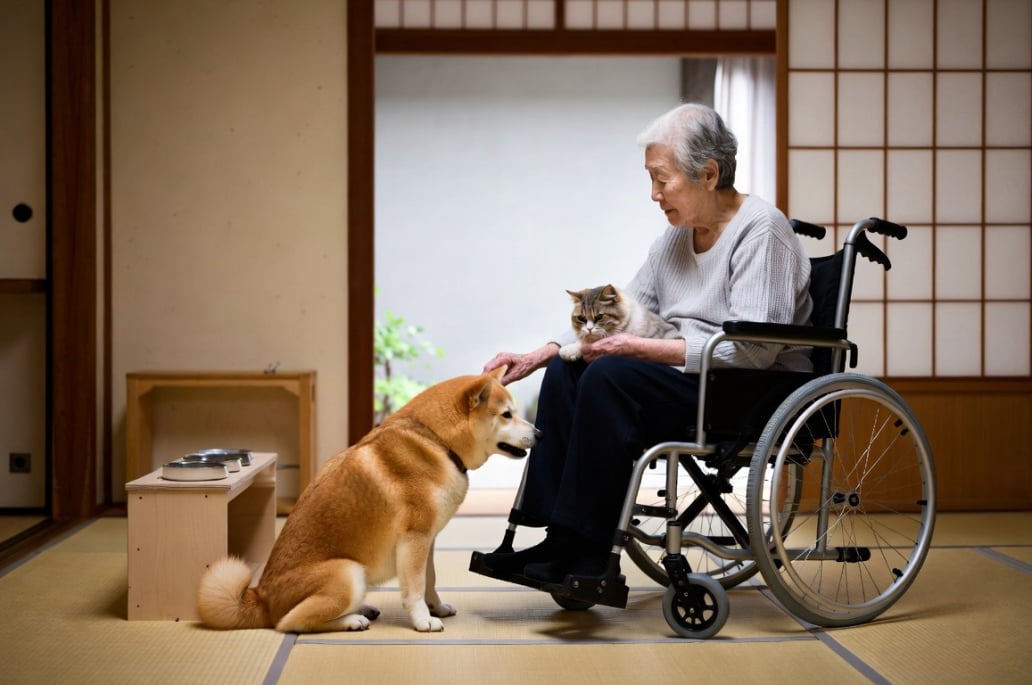
When Moving Is Hard: Pet Care for Limited Mobility
Not every senior can bend down, walk far, or grip tightly. Yet the desire for pets for the elderly remains strong. This article addresses real challenges with real solutions. Communication with animals does not require athletic ability. Pet care can be adapted at every level. The benefits of communicating with animals are available even to seniors who use wheelchairs, walkers, or who are mostly bedridden. The key is to redesign tasks, not abandon them. Thousands of seniors with limited mobility share their homes happily with cats, small dogs, rabbits, or birds. This guide shows how to remove physical barriers so that communication with animals flows naturally every single day.
Start with feeding. Bending to the floor is painful or impossible for many seniors. The solution is to raise the bowls to a comfortable height. Place food and water on a sturdy low table, a stack of books, or an inverted plastic crate. Pets for the elderly adapt quickly to higher feeding stations. Communication with animals at mealtime remains joyful when the senior is not in pain. The benefits of communicating with animals include the pet learning to wait calmly while the senior prepares food from a seated position. Pet care of this kind preserves energy for more important moments—cuddles, gentle talk, and shared quiet time. One senior uses a long-handled dustpan to push the food bowl toward her cat without standing up.
Next, address grooming without fine motor control. Gripping a small brush can be hard for arthritic hands. Use a grooming glove instead—slip it on like a mitten and simply pet the animal. Communication with animals through gentle stroking happens automatically. The benefits of communicating with animals with a glove include reduced hand cramps and less frustration. For pets for the elderly who are cats or short-haired dogs, a damp washcloth wrapped around a ruler works as an extended grooming tool. Pet care can be creative. A senior with Parkinson’s told us she rests her hand on a pillow while her cat rubs against her fingers—that counts as grooming too. Perfect is the enemy of good. Imperfect care is still care.
Litter box management is often the biggest worry. Seniors who cannot scoop daily due to back pain or balance issues can use disposable aluminum pans instead of heavy plastic boxes. When the pan becomes dirty, simply lift it with both hands (using a walker for support) and replace it. Communication with animals stays positive when the environment is clean. The benefits of communicating with animals include the cat feeling respected and the senior feeling capable. Another option is placing the litter box on a low-wheeled cart. Pull the cart to you, scoop while seated, and push it back. Pets for the elderly do not care about fancy systems—they care about consistency. A clean box, however you achieve it, keeps everyone happy.
For seniors who use wheelchairs, playing with a pet requires adaptation. Attach a soft toy to a long ribbon or an old fishing rod (without the hook). Dangle the toy at pet height while sitting. Communication with animals through play becomes a seated activity. The benefits of communicating with animals in play include laughter and shared focus. Pet care does not mean chasing a pet around the house. Pets for the elderly who are young or energetic may need more, but senior pets are often a perfect match for senior humans. An 80-year-old in Nagoya adopted a 12-year-old small dog. Both have arthritis. Both nap together. Their communication with animals is slow, peaceful, and perfectly matched.
Finally, what if a senior is bedridden for days or weeks? Pet care can still continue. Keep a small basket next to the bed with dry food, treats, and a water bottle with a long straw for pets to drink from. Communication with animals through voice becomes the primary channel. Talk to your pet. Sing. Describe what you see outside the window. The benefits of communicating with animals through voice alone are well documented—pets recognize tone and presence. Pets for the elderly who are cats often climb onto the bed and stay. A small dog can be lifted onto the mattress using a towel as a sling. Family members or neighbors can help with litter or walks twice a week. The bond remains. Pet care can shrink to the size of a bed. What matters is that the benefits of communicating with animals continue to flow—quietly, gently, without shame or hurry.